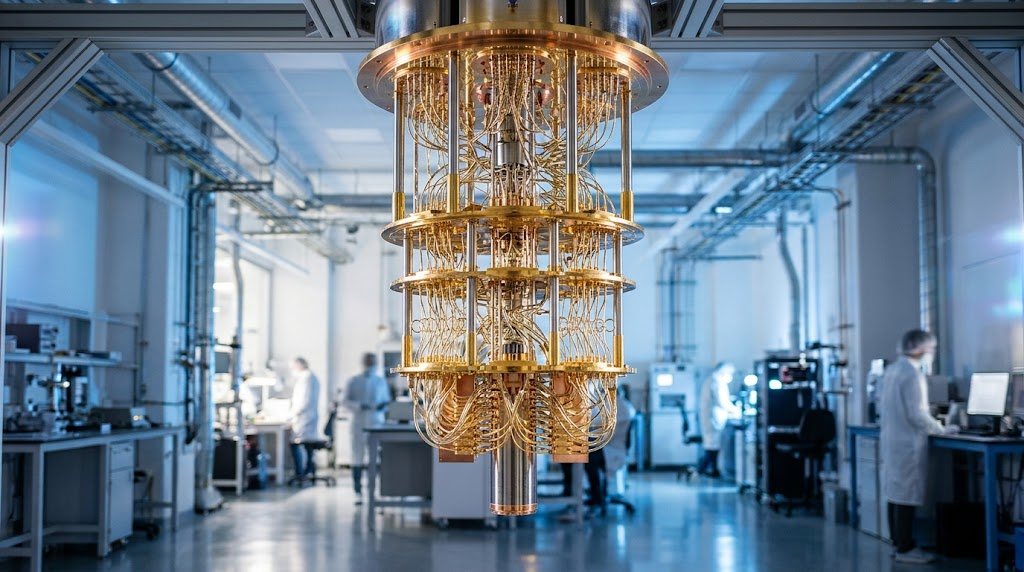
Google's Willow chip, its verifiable Quantum Echoes result and IBM's steady roadmap have moved quantum computing closer to useful work. Here is what has been achieved and how to get ready.
For years, quantum computing lived mostly in the future tense. Over the past two years, that has started to change. Google and IBM have each reported concrete, peer-reviewed or publicly tracked milestones that move the field from theory toward useful work.
Business leaders do not need to become physicists to benefit. They do need a clear picture of what has been achieved, where the technology is heading and which simple steps help an organization get ready.
Milestone one: Willow and error correction
The central challenge in quantum computing is error. Qubits, the basic units of a quantum computer, are fragile. Errors also tend to multiply as systems grow. For nearly three decades, researchers have pursued a goal known as operating "below threshold," where adding more qubits reduces errors instead of increasing them.
In December 2024, Google announced that its 105-qubit Willow chip had reached that goal. As the team grew its grid of encoded qubits from 3 by 3 to 5 by 5 to 7 by 7, the error rate was cut in half at each step. Google described Willow as the first system below threshold and a strong prototype for a scalable logical qubit.
Willow also completed a benchmark computation in under five minutes that Google estimates would take Frontier, one of the world's fastest supercomputers, about 10 septillion years. That benchmark has no direct commercial use, but it demonstrated the raw potential of the hardware.
Milestone two: Quantum Echoes and verifiable advantage
The next step was to show a quantum computer doing something useful that can also be checked. On October 22, 2025, Google announced exactly that, with research published in Nature.
The algorithm, called Quantum Echoes, sends a signal through the qubits, nudges one of them, then runs the sequence in reverse and measures the "echo" that returns. Google reports that it ran 13,000 times faster on Willow than the best classical algorithm on one of the world's fastest supercomputers.
Two features make this milestone important for business:
- It is verifiable. The result can be repeated on the same quantum computer, or on another of similar quality, to get the same answer.
- It points toward real applications. In a proof-of-principle experiment with the University of California, Berkeley, the team used the method to study two molecules, one with 15 atoms and one with 28. The results matched traditional nuclear magnetic resonance (NMR) measurements and revealed information NMR does not usually provide.
NMR is the science behind MRI machines and a workhorse of chemistry and drug discovery. A quantum tool that extends it could help researchers understand molecular structure in new detail.
Why verifiability matters
Earlier quantum demonstrations were impressive but hard to check, because no classical computer could reproduce the answer. Verifiable results change that. When a result can be repeated and confirmed, scientists and companies can trust it enough to build on it.
That is the bridge from laboratory benchmark to business tool. A pharmaceutical researcher or materials scientist needs answers that hold up, not just answers that arrive quickly. Quantum Echoes shows that quantum computers are beginning to produce results with both qualities.
Google has said its focus now is the next step on its roadmap: a long-lived logical qubit. As it scales toward a full-scale, error-corrected machine, the company expects more useful applications to follow.
Milestone three: IBM's clear roadmap
IBM has taken a distinctive approach: publishing a detailed, dated roadmap and reporting progress against it.
In June 2025, IBM announced plans to build IBM Quantum Starling, a large-scale, fault-tolerant quantum computer, at a new IBM Quantum Data Center in Poughkeepsie, New York, by 2029. Starling is designed to run 100 million quantum operations using 200 logical qubits, about 20,000 times more operations than today's quantum computers. A follow-on system, Blue Jay, is planned to run 1 billion operations across 2,000 logical qubits.
In November 2025, IBM delivered the next set of steps:
- Nighthawk, a 120-qubit processor with 218 tunable couplers that supports circuits about 30% more complex than its predecessor, with up to 5,000 two-qubit gates. IBM projects 7,500 gates by the end of 2026.
- Loon, an experimental processor demonstrating the key components needed for fault-tolerant computing.
- Real-time error decoding in under 480 nanoseconds, achieved a year ahead of schedule.
- A move to 300mm wafer fabrication in Albany, New York, which IBM says doubled its research and development speed.
IBM also said it expects the wider research community to confirm the first verified cases of quantum advantage by the end of 2026, and it helped launch an open, community-led tracker to monitor candidate results. IBM, Algorithmiq, the Flatiron Institute and BlueQubit contributed the first entries, which cover three kinds of experiments, including problems whose answers can be checked efficiently on classical computers.
The software side is moving just as quickly. IBM reported that scaled dynamic circuits in its Qiskit software raised accuracy by 24% on circuits with more than 100 qubits. It also plans a C++ interface and, by 2027, libraries for machine learning and optimization, which would make quantum methods easier for business developers to try.
Where business value is likely to appear first
Both companies point to similar early opportunities. IBM names drug development, materials discovery, chemistry and optimization. Google highlights drug discovery, better batteries for electric vehicles and new energy sources.
Chemistry and materials
Molecules follow the rules of quantum physics, so quantum computers are naturally suited to simulating them. That makes pharmaceuticals, specialty chemicals and battery materials early candidates.
Optimization
Routing, scheduling and portfolio construction involve enormous numbers of possible combinations. Quantum methods may eventually help find stronger solutions to some of these problems.
Hybrid computing
The near-term pattern is quantum and classical computers working together. IBM's Qiskit software now connects quantum processors with high-performance computing for error mitigation, a sign of how the two will share work.
Getting quantum-ready
Quantum computing is still early, and the largest benefits lie ahead. Organizations can start learning today with modest effort. A practical approach:
- Assign a curious owner. One person who tracks milestones from Google, IBM and others can brief leadership twice a year.
- Map your hardest problems. List the simulation, scheduling or optimization challenges where better answers would create real value.
- Experiment through the cloud. IBM and others offer access to real quantum hardware through cloud platforms and open-source tools such as Qiskit, so teams can learn without buying equipment.
- Build partnerships. Universities, research labs and technology providers welcome industry problems to test.
- Revisit annually. Roadmaps are moving quickly. A yearly review keeps plans aligned with what the hardware can actually do.
Willow, Quantum Echoes and IBM's steady roadmap progress mark a genuine turning point. The leaders who start exploring now will be ready when quantum computing moves from milestone to everyday tool.
Sources
- Google Blog, "Meet Willow, our state-of-the-art quantum chip," Dec. 9, 2024
- Google Blog, "Our Quantum Echoes algorithm is a big step toward real-world applications for quantum computing," Oct. 22, 2025
- Google Quantum AI and collaborators, "Observation of constructive interference at the edge of quantum ergodicity," Nature, Oct. 22, 2025
- IBM Newsroom, "IBM Sets the Course to Build World's First Large-Scale, Fault-Tolerant Quantum Computer at New IBM Quantum Data Center," June 10, 2025
- IBM Newsroom, "IBM Delivers New Quantum Processors, Software and Algorithm Breakthroughs on Path to Advantage and Fault Tolerance," Nov. 12, 2025